
Commercial HVAC Replacement in Orange County: A Multifamily Project Planning Guide
Once ownership has approved an HVAC replacement, the property manager must turn that decision into a workable project plan. For property managers facing commercial HVAC replacement in Orange County, work at an occupied multifamily property involves more than selecting new equipment and scheduling an installation date.
The project may affect residents, maintenance personnel, parking areas, rooftop access, and other contractors working at the property. A clearly defined plan helps the management team control these variables before work begins.
For Orange County properties, early coordination is especially important when work must be completed before periods of high cooling demand. Property managers should establish the project scope, identify infrastructure requirements, and prepare residents for any anticipated service interruptions.
Establish the Replacement Scope
The first step is defining exactly what the replacement project includes. Property managers should identify the equipment being replaced, the buildings or areas served by that equipment, and any systems that may be addressed during a later phase.
The scope should document:
- The equipment scheduled for replacement
- The buildings, units, or common areas affected
- Known performance or comfort concerns
- Ownership’s budget and approval requirements
- Target completion dates
- Access or scheduling limitations
- Equipment that may be included in future phases
Existing service records can provide useful background for the contractor. Repair histories may identify recurring problems, previously replaced components, access difficulties, and conditions that should be investigated before the new equipment is ordered.
A defined scope also makes it easier to compare proposals. Without one, contractors may base their recommendations on different assumptions, making price and project comparisons less reliable.
Evaluate the Existing Property Infrastructure
Replacement equipment must work with the property’s existing infrastructure. A site evaluation should examine more than the unit being removed.
Depending on the system and property, the contractor may need to review:
- Electrical capacity
- Existing HVAC controls
- Refrigerant piping
- Condensate drainage
- Ventilation requirements
- Equipment curbs and structural supports
- Roof and mechanical-room access
- Ductwork condition and airflow
Commercial ductwork installation or modification may be necessary if the current duct system is damaged, improperly sized, or incompatible with the replacement equipment. Other projects may require curb adapters, electrical changes, control upgrades, or airflow balancing.
Identifying these requirements during planning gives ownership a more complete understanding of the project. It can also reduce change orders caused by conditions discovered after the old equipment has been removed.
Determine Whether the Replacement Should Be Phased
Replacing every system at once may not fit the property’s capital budget or operating schedule. For larger multifamily properties, a phased replacement program may provide a more practical approach.
The first phase can prioritize equipment serving the most critical areas or systems that have already been approved for replacement. Later phases can be scheduled around future capital budgets, seasonal demand, or other property improvements.
In some cases, the overall plan may combine full replacement with a targeted commercial HVAC retrofit. Equipment that remains serviceable may benefit from targeted control upgrades, component replacements, or efficiency improvements while obsolete systems are replaced.
A phased plan should account for repeated costs. Multiple phases may require separate permits, crane mobilizations, equipment deliveries, resident notices, and contractor staging. These expenses should be considered when determining whether to divide the work or complete a larger portion at one time.
Coordinate Resident Notices and Unit Access
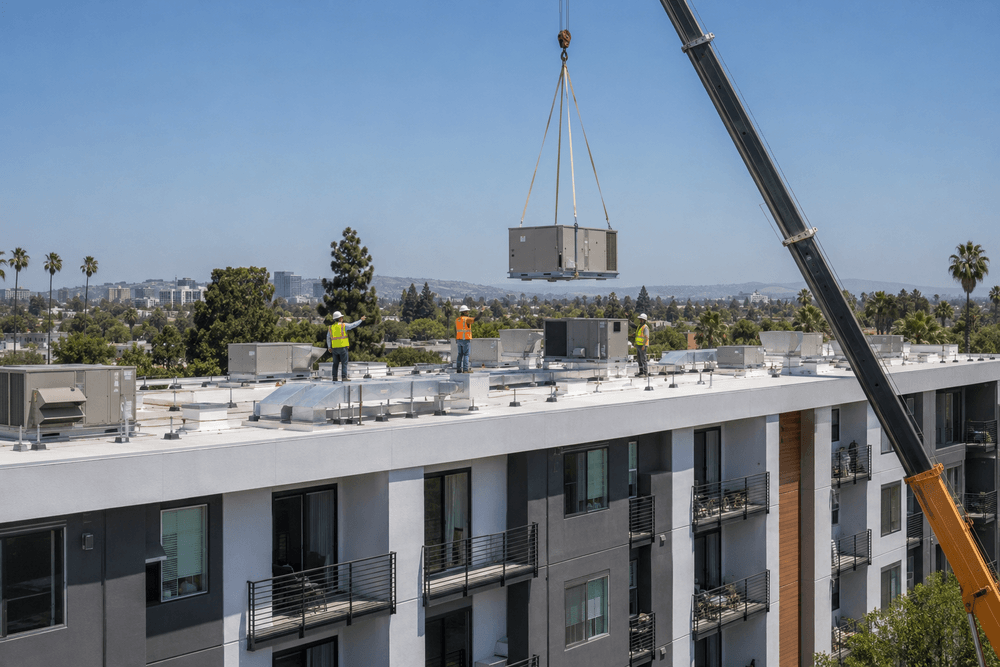
At an occupied multifamily property, HVAC replacement can affect residents even when most of the work occurs on the roof or in a central mechanical area. Crane activity, construction noise, restricted parking, unit access, and temporary cooling interruptions can interfere with residents’ daily routines, particularly for those who work from home.
Before work begins, the property management team should establish a clear communication and access plan using scheduling and access information supplied by the HVAC contractor. Key details should include:
- Unit-entry protocols: Identify which apartments require indoor access and establish practical service windows.
- Resident notice timelines: Provide sufficient advance notice so residents can adjust work schedules, make arrangements for pets, or plan around temporary service interruptions.
- Disruption windows: Define realistic time periods for crane activity, heavy noise, localized power interruptions, and HVAC shutdowns.
- On-site accommodations: When practical, consider making a clubhouse, business center, or other common area available to residents who need a quieter workspace during daytime construction.
- Escort and security procedures: Confirm approved working hours and whether management personnel must accompany technicians inside occupied units.
- Communication responsibilities: Designate a point of contact for scheduling changes, missed-access appointments, and resident concerns.
Resident notices should explain what work is taking place, when it is scheduled, which areas will be affected, and what residents should expect. The information should be specific enough to support planning without promising exact completion times or conditions the contractor and management team cannot fully control.
Plan for Rooftop Access, Cranes, Parking, and Staging
Commercial HVAC replacement frequently requires logistical coordination beyond the mechanical work itself. Equipment may need to be delivered by crane or moved through areas normally used by residents, vendors, and property employees.
Depending on the equipment and property conditions, the property manager may need to coordinate with the HVAC contractor and other applicable vendors to review:
- Crane placement and lifting areas
- Roof access and fall-protection requirements
- Parking spaces that must be temporarily closed
- Delivery routes and gate access
- Landscaping and overhead obstructions
- Equipment and material staging
- Emergency vehicle access
- Removal and disposal of existing equipment
These details should be confirmed before the installation date. A crane that cannot safely reach the designated equipment area or a delivery truck that cannot access the property may delay the project and extend service interruptions.
Consider Equipment Standardization
A replacement project may provide an opportunity to standardize equipment across the property. Using consistent equipment where appropriate can make future maintenance, filter ordering, parts management, and service procedures easier to standardize.
Standardization is not always possible. Different buildings may have different capacities, layouts, electrical requirements, or ventilation needs. Equipment should be selected for the actual conditions rather than consistency alone.
After installation, the property’s records should be updated with:
- Manufacturer and model
- Serial number
- Installation date
- Warranty information
- Filter sizes and service requirements
- Location and area served
- Recommended maintenance schedule
Accurate records give property managers and maintenance personnel a reliable equipment inventory for future budgeting and service planning.
Plan Replacement Before Peak Cooling Demand
Once replacement has been approved, unnecessary delays can increase the risk that declining equipment will fail before the planned installation. Scheduling the work proactively gives the property manager more control over equipment selection, contractor availability, resident notices, and ownership approvals.
Aquinas HVAC provides commercial HVAC services in Santa Ana and throughout Orange County for commercial and multifamily properties. Property managers can contact Aquinas to discuss equipment replacement needs, existing site conditions, and scheduling considerations for an occupied property.