Commercial HVAC Maintenance San Jose: Why Office Buildings Fail Between Visits
Commercial HVAC maintenance San Jose office buildings depend on is designed to prevent unexpected breakdowns. Yet many properties still experience system failures between scheduled service visits.
Office buildings in San Jose rarely fail because no maintenance was performed. More often, failures occur in the gap between inspections.
In the Santa Clara Valley, commercial HVAC systems operate under long cooling seasons, fluctuating occupancy, and extended weekday run times across office buildings in San Jose.
Even with routine service in place, performance issues can develop gradually until tenants begin reporting comfort complaints.
Maintenance Intervals vs. Real Operating Conditions
Most office properties follow quarterly or bi-annual service schedules. On paper, that appears sufficient.
For a broader look at what routine office building HVAC maintenance in San Jose typically includes and where its limits begin, see our detailed breakdown of maintenance scope and performance boundaries.
In practice, San Jose office buildings often run HVAC systems 10–12 hours per day, five to six days per week. Mixed-use properties may run even longer. Equipment that operates under this load can degrade faster than maintenance cycles anticipate.
When maintenance intervals do not match real runtime conditions, performance begins to drift between visits.
Common Failure Patterns Between Service Calls
Air Filter Restrictions Reappear Faster Than Expected
Air filter changes are a core part of hvac maintenance for office buildings. However, in high-occupancy buildings, filters can load faster than anticipated.
When filters become restricted:
- Airflow complaints increase
- Cooling response times slow
- Tenant comfort calls rise
By the time the next hvac maintenance inspections office buildings are scheduled for, the issue has already affected occupants.
Routine air filter changes during service visits reduce these complaints, but interval frequency must align with building usage.
Heating and Cooling Mode Testing Misses Transitional Drift
During scheduled visits, technicians test heating and cooling modes to confirm proper operation.
However, transitional periods in San Jose, especially spring and fall, can expose weaknesses not evident during standard testing. Control sequences that function during a single test may drift once systems operate continuously in one mode.
This contributes to office hvac system failures that appear unexpected, even though the equipment passed inspection weeks earlier.
Consistent heating and cooling mode testing during each service visit helps identify control instability before it escalates.
Evaporator Coil Buildup Between Visits
Evaporator coil inspections are essential in commercial environments.
In office buildings, dust accumulation, filter bypass, and high runtime hours contribute to gradual coil restriction. Even moderate buildup can reduce heat transfer efficiency.
The result is:
- Extended runtime
- Reduced cooling output
- Higher tenant complaints
Without coil inspections during each commercial hvac maintenance san jose visit, minor buildup compounds until it presents as a service call.
Drain Line Blockages Develop Quietly
Condensate management issues are a frequent source of emergency calls.
Drain pan tablets and nitrogen drain line clearing are preventative measures that reduce microbial growth and debris buildup. However, between visits, drain lines can partially restrict.
Early-stage blockages often go unnoticed until:
- Overflow safeties trigger
- Water appears near ceiling tiles
- Units shut down unexpectedly
In San Jose commercial hvac services environments, even minor drainage restrictions can escalate quickly during peak cooling months.
Electrical Connections Loosen Under Continuous Operation
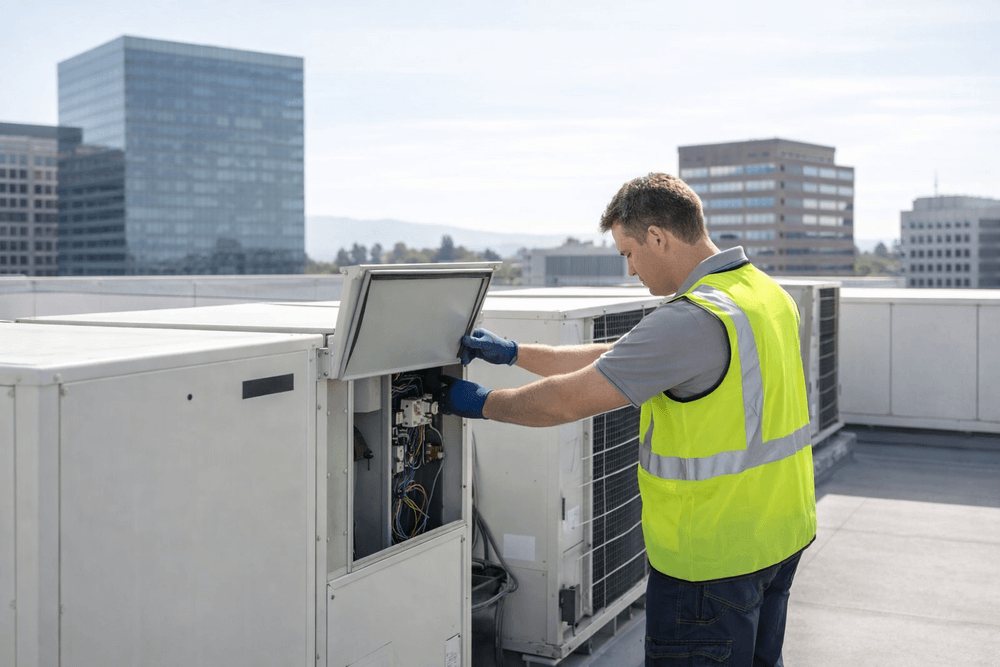
Electrical connection tightening is a standard maintenance task.
Office rooftop units and packaged systems experience vibration and thermal cycling throughout daily operation. Over time, connections can loosen, creating intermittent faults.
These may not be evident during short service windows but can surface weeks later as:
- Random shutdowns
- Compressor lockouts
- Control board faults
Electrical reliability checks during maintenance visits reduce these risks, but high-runtime environments increase the likelihood of drift between inspections.
Refrigerant Line Degradation Over Time
Refrigerant line inspections are often visual and pressure-based during service.
Small insulation breakdowns, minor leaks, or vibration wear may not trigger immediate alarms. Yet under extended cooling demand, these minor issues become larger performance problems.
This leads to:
- Gradual capacity loss
- Longer cooling cycles
- Higher complaint frequency
For commercial hvac contractors san jose properties rely on, identifying small refrigerant issues early prevents recurring service calls.
AC Unit Leveling and Structural Shifts
AC unit leveling checks are frequently overlooked as a failure cause.
Rooftop units that settle unevenly can affect drainage, vibration patterns, and component wear. Over time, improper leveling contributes to:
- Drainage issues
- Premature mechanical stress
- Repeated minor faults
In older San Jose office buildings, structural settling can compound this issue between visits.
The Real Issue: Maintenance Gaps, Not Neglect
Most office buildings in the Santa Clara Valley are not under-maintained. They are under-aligned.
The gap between scheduled service and real operational stress creates hvac maintenance gaps office buildings experience but rarely identify.
Commercial hvac performance issues tend to cluster:
- After peak cooling cycles
- During seasonal changeovers
- Following high-occupancy periods
When maintenance frequency, inspection depth, or runtime tracking does not reflect actual usage, failures appear “sudden” even though they developed gradually.
Stabilizing Office HVAC Performance in San Jose
For building owners and property managers managing multiple tenants in office buildings, recurring HVAC calls create operational disruption and reputational strain.
Stabilizing performance requires structured commercial maintenance programs aligned with actual runtime conditions.
These may include:
- Consistent air filter replacement aligned with runtime
- Reliable heating and cooling mode testing
- Evaporator coil inspections
- Drain pan tablets and nitrogen drain line clearing
- Electrical connection tightening
- Refrigerant line inspections
- AC unit leveling checks
Office buildings across the region rely on structured commercial hvac services San Jose providers deliver to reduce these recurring failures.
For San Jose Office Properties Experiencing Recurring HVAC Issues
If your office building is experiencing repeated HVAC failures between scheduled visits, the issue may not be lack of maintenance, but alignment.
We also examine long-term office system stability in our analysis of HVAC for office buildings in San Jose.
Our team works with office building owners, property managers, and mixed-use operators throughout San Jose to identify where maintenance gaps are occurring and stabilize system performance.