Commercial HVAC Maintenance Orange County: What Programs Actually Include
Commercial HVAC systems in our Orange County service area operate year-round. Regular commercial hvac maintenance in Orange County is essential to ensure reliable operation. Office buildings, retail centers, and multi-family properties depend on consistent performance under steady load.
When maintenance programs are described vaguely, property managers are left guessing what actually occurs during a service visit. A clearly defined scope removes that uncertainty.
This guide explains what a structured maintenance visit includes and why each task matters.
Why Defined Scope Matters
Maintenance is preventative. It is not a repair visit and it is not a capital planning exercise. It is a scheduled inspection and service process designed to support airflow, drainage, electrical stability, and overall system performance.
Without a clearly defined HVAC maintenance scope, commercial HVAC maintenance programs can vary widely in quality and consistency. Transparent service expectations allow property managers to understand what is performed and what falls outside routine service.
For Orange County properties with continuous cooling demand, clarity prevents misunderstandings and supports predictable building operations.
Air Filter Replacement
Clean air filters support proper airflow and indoor air quality.
During service visits, technicians:
- Replace air filters
- Confirm proper sizing and fit
- Check for airflow restriction
Restricted airflow increases system strain and reduces efficiency. Over time, clogged filters can contribute to overheating and premature component wear.
For office buildings and multi-family properties, consistent filter replacement is one of the simplest and most important maintenance steps.
System Testing in Heating and Cooling Modes
Each visit includes operational testing in both heating and cooling.
Technicians:
- Run the system in cooling mode
- Run the system in heating mode
- Verify thermostat response
- Confirm proper changeover
Testing both modes ensures the equipment responds correctly as seasonal demands shift. In Orange County, where systems may cycle between heating and cooling throughout the year, this verification is critical.
Evaporator Coil Inspection
Evaporator coils are responsible for heat transfer. When buildup accumulates, cooling performance declines.
Maintenance includes:
- Visual inspection of evaporator coils
- Identifying dirt accumulation or obstruction
Clean, unobstructed coils allow for efficient heat exchange. Early detection of buildup helps prevent reduced capacity and unnecessary energy consumption.
Drain Pan Treatment and Condensation Line Clearing
Drainage reliability is a core part of preventative maintenance.
Add algae tablets to the drain pan
Algae tablets help reduce biological growth that can block water flow and cause overflow conditions.
Blow out condensation drain lines with nitrogen
Clearing drain lines removes debris and buildup that restrict drainage.
Blocked lines can lead to ceiling damage, mechanical room moisture, or interior water intrusion. Routine drain maintenance helps reduce that risk.
Electrical Connections
Electrical reliability directly affects equipment stability.
Loose connections can cause intermittent operation and premature component failure. Ensuring secure electrical contact reduces operational disruption and supports long-term reliability.
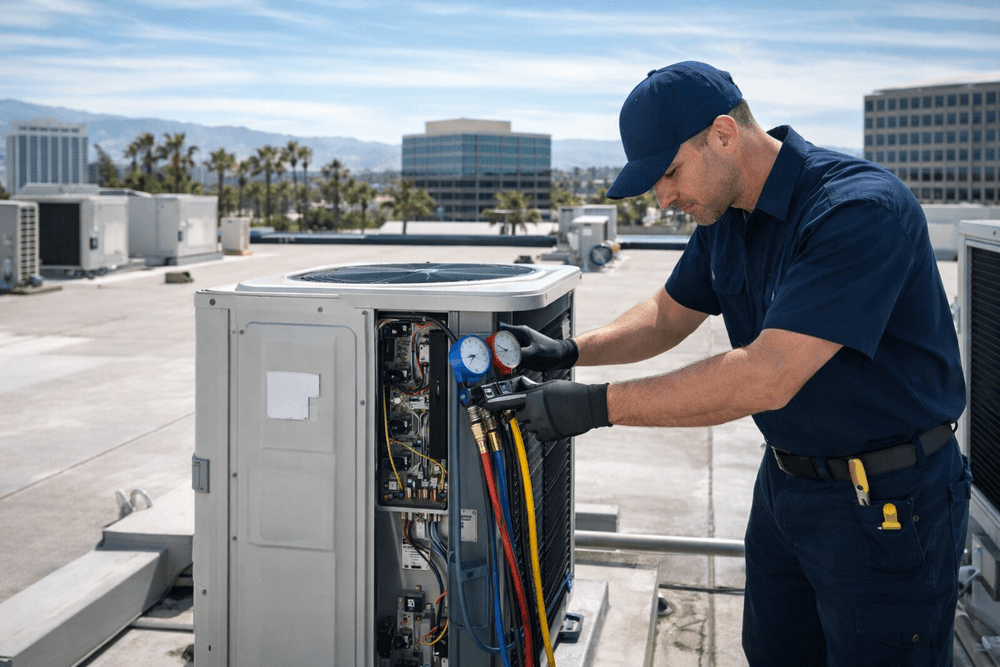
As part of routine maintenance, technicians tighten all electrical connections to help maintain stable performance and reduce the risk of unexpected interruption.
Refrigerant Line Inspection
Refrigerant lines must remain intact and properly insulated.
Maintenance includes:
- Inspecting refrigerant line insulation
- Checking for visible wear or damage
- Confirming lines are properly supported
Damaged insulation can reduce cooling efficiency and contribute to unstable operating conditions. Identifying visible issues early helps maintain consistent performance.
Verifying Unit Level
Exterior condensers and rooftop units can shift over time due to weather exposure or structural movement.
Technicians verify that AC units remain level. An unlevel unit can affect proper oil return to the compressor and impact long-term mechanical reliability.
This step, while simple, supports stable system operation.
Commercial and Multi-Family Considerations
The mechanical tasks are consistent across property types, but operational priorities differ.
Office buildings often prioritize uninterrupted daytime comfort and tenant productivity, supported by commercial HVAC services. Multi-family properties must consider shared infrastructure and resident coordination, supported by multi-family HVAC services.
Structured maintenance programs support both environments by maintaining predictable service procedures.
What Commercial HVAC Maintenance Programs Do Not Include
Routine maintenance is preventative in nature. It focuses on inspection, cleaning, testing, and verification.
Major repairs, part replacements, and emergency service calls are handled separately when required. Clearly separating routine service from repair work prevents confusion and supports transparent service agreements.
Operational Stability Through Preventative Service
Commercial HVAC maintenance in Orange County is most effective when its scope is clearly defined. Changing filters, testing system modes, inspecting coils, treating drains, tightening electrical connections, reviewing refrigerant lines, and verifying unit level all contribute to reliable performance.
For commercial and multi-family property managers, structured maintenance visits provide consistency and measurable oversight of system condition.
Property managers seeking information about maintenance program options can contact Aquinas HVAC to review service structure and scheduling.